Health and Safety Policy — Flat Clearance Chiswick
Policy statement and purpose
 This Health and Safety Policy sets out the approach Flat Clearance Chiswick adopts to protect employees, contractors, residents and the public when carrying out flat clearance, waste collection and rubbish removal services. The purpose is to define responsibilities, clarify safe working methods and ensure that our clearance services and waste handling operate with consistent risk control. We seek to minimise hazards associated with bulky waste removal, house clearance and routine rubbish collection across our designated rubbish company service area while meeting all relevant legal expectations.
Scope: this policy applies to all staff, agency personnel, self-employed operatives and sub-contractors engaged in waste clearance, junk removal and recycling tasks. It covers site preparation, manual handling, vehicle loading, segregation of recyclable materials and hazardous items, and the use of mechanical aids. The policy supports company procedures for safe access and egress, the provision of suitable PPE and the safe operation of vans and skip-loading equipment. It also underlines the need for recorded risk assessments and job-specific safe systems of work.
 Responsibilities: management must ensure adequate resources, training and supervision are provided and that risk assessments are current. Operatives are required to follow instructions, report hazards, and use personal protective equipment correctly. Key duties include:
- Carrying out and keeping up-to-date site risk assessments for each clearance task
- Ensuring mechanical aids and lifting equipment are maintained
- Identifying and segregating hazardous waste and sharps
Hazard identification: common risks include manual handling injuries, slips, trips and falls from uneven surfaces, cuts from glass or metal, encounters with biological contaminants and exposure to potentially hazardous materials. The rubbish removal and skip-loading process can also expose staff to road traffic hazards when operating in curbside locations or service areas. Controls include pre-job inspections, clear exclusion zones, and the use of appropriate lifting techniques and handling aids to reduce the likelihood of musculoskeletal injury.
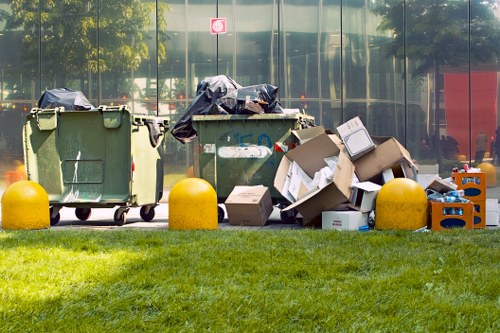 Safe systems of work: all clearance tasks are planned and communicated. Job briefs or toolbox talks are held before complex or high-risk removals. Vehicles are loaded to manufacturer limits, and cargo is secured during transit. When dealing with potentially hazardous content such as chemicals, asbestos-containing materials or contaminated items, the team will apply strict segregation procedures and follow waste transfer documentation requirements. The emphasis is on a methodical approach that protects both staff and the wider community within the rubbish service area.
Training and competence: staff receive induction training, manual handling instruction, and specific coaching for waste segregation, safe use of trolleys and lifting equipment, and interaction with householders. Records of training, competence checks and licences for specialist plant are maintained. Emergency preparedness is part of the training regime: first aid, spill response and fire awareness are included so operatives can respond safely and efficiently if incidents arise.
Monitoring, reporting and continuous improvement: incidents, near misses and safety observations are recorded and investigated to prevent recurrence. Regular audits of vehicle safety, PPE provision and compliance with waste transfer notes support accountability. Environmental best practice is encouraged through recycling, reuse and correct disposal of materials recovered during clearance, aligning the company's operations with sustainable waste management principles across the wider rubbish removal territory.
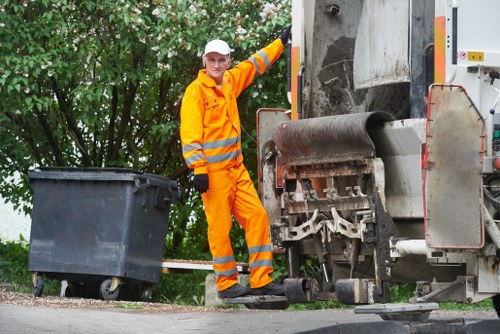 Emergency procedures: in the event of fire, major spill or serious injury, the operative in charge will implement site emergency protocols, secure the area and notify emergency services as required. Spill kits, containment materials and appropriate PPE are supplied on vehicles and at operational bases. Contractors working on joint tasks must be briefed on emergency contacts and assembly points and must cooperate fully with incident investigations to ensure lessons are learned and communicated.
 Review and governance: this policy is reviewed at least annually or after any significant change in operations, equipment or legislation. Management will ensure that the policy remains appropriate to the scale and nature of the flat clearance and rubbish collection services provided. Accountability lies with senior managers to demonstrate compliance through documented procedures, audits and corrective actions. Everyone engaged in clearance activities is expected to contribute to a positive safety culture by reporting hazards, complying with controls and suggesting improvements.
Key commitments
Flat Clearance Chiswick commits to maintaining a safe working environment for all activities related to household and communal waste removal, furniture clearance, and sustainable rubbish collection solutions. We will:
- Provide leadership and resources to implement this policy effectively
- Assess and control risks associated with clearance and waste handling
- Provide training, suitable PPE and safe equipment
- Investigate incidents promptly and act on findings
- Support recycling and responsible disposal across our service locations
Signed on behalf of the company: [Policy Owner Signature Placeholder]. Review cycle: annually or sooner if operations or legislation change. This document is a formal statement of intent and operational expectations for our waste clearance, rubbish removal and collection teams working across our service area.